MSC-3 SERIES / INTEGRATION BRIEF
MeshSat for integrators
A pocket gateway concept for a team's radios, with an Iridium path for text, status and positions.
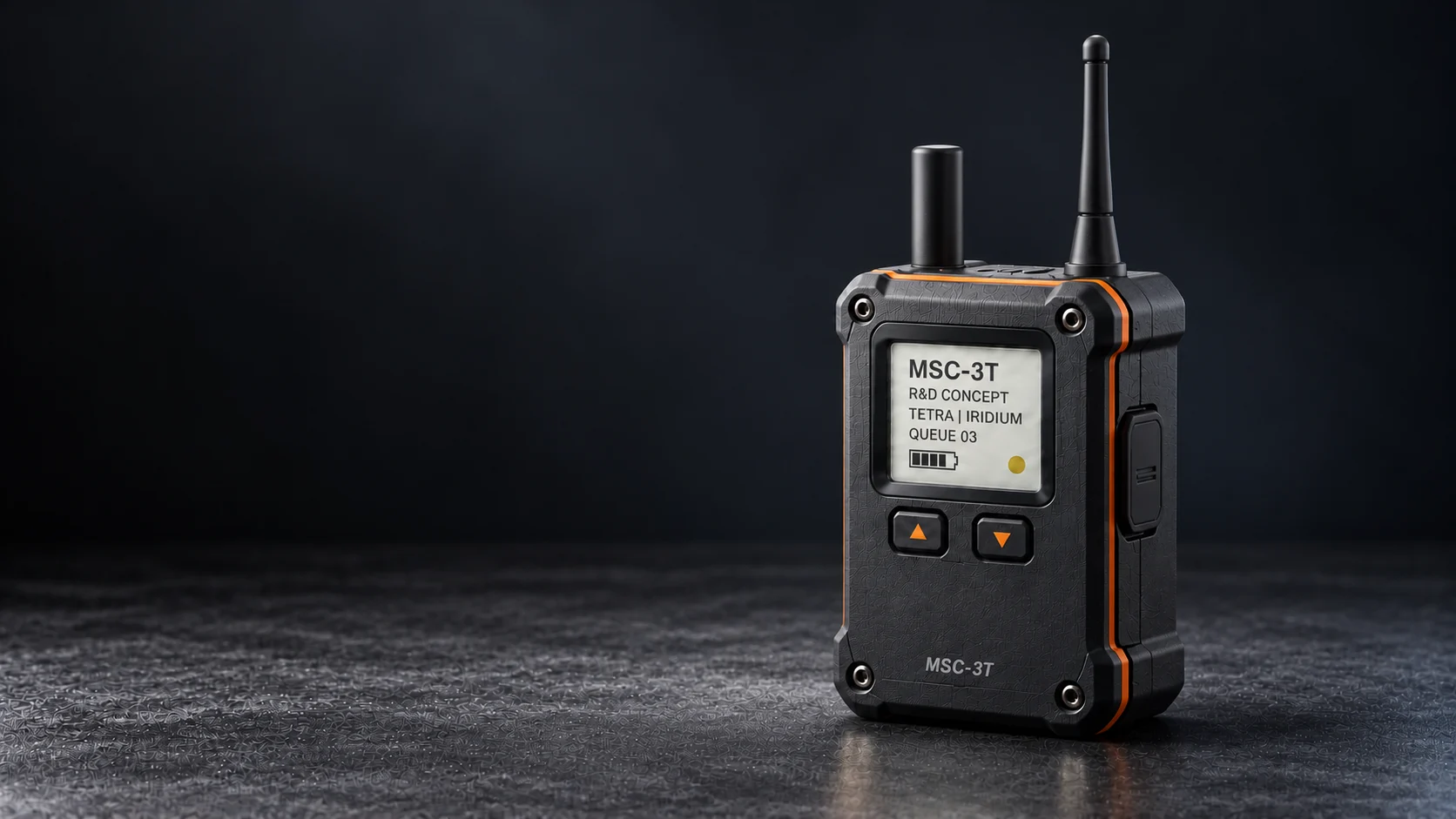
MSC-3T / FUTURE PLAN. R&D concept render by MeshSat. Enclosure, hardware and RF integration remain unverified.
One platform. One or two local radios. Iridium in every variant.
R&D scope, not a validated device specification. No MSC-3 variant has been deployed to a real user. Not an emergency service.
THE FILM / 17:13
MeshSat, explained
From the idea of bridging networks that disasters cut apart, down to the bytes of an SOS on the wire. Every MSC-3 concept runs the MeshSat Bridge, the routing layer the film shows.
TWO CHAPTERS FOR INTEGRATORS
Audio in English, Dutch or Greek, with subtitles in all three (the gear icon, then Audio track). Nothing loads from YouTube until you press play.
01 / SHARED PLATFORM
One platform, different local radios
The letters after MSC-3 identify the local radios fitted in the concept. Iridium is always included and does not need a letter.
| Compute | Raspberry Pi Zero 2 W running MeshSat Bridge. | Processing load and peripheral integration need validation for each configuration. |
|---|---|---|
| Satellite | Ground Control RockBLOCK 9704 using Iridium IMT. | Message transport. No voice or broadband service over this path. |
| Local radios | One or two radio-module slots; T, D, L, A, H or G. | Each pairing needs mechanical fit, antenna isolation and transmit coordination work. |
| Enclosure / power | Rugged pocket case and battery. | Dimensions, mass, runtime, environmental rating and charging design are unverified. |
| Status display | Small colour e-paper display compatible with the Raspberry Pi, under evaluation. | Panel, driver, interface, power demand and mechanical integration require validation. |
| Message routing | Local radio to local radio, and local radio to Iridium, in both directions. | Only supported message types can cross a route. Protocol conversion and encryption boundaries need validation. |
| Integration status | FUTURE PLAN Every MSC-3 variant. | Module specifications do not establish device certification, fleet approval or end-to-end performance. |
MSC-3T / ENCLOSURE STUDY
Display, controls and handling
A small colour e-paper display compatible with the Raspberry Pi is under evaluation. These views explore the enclosure and controls; ergonomics and antenna placement still require testing.
02 / CAPABILITY MATRIX
Local interfaces, shared satellite path
Intended message paths for evaluation. Each single-radio concept below includes Iridium; a two-radio concept also bridges its local radios to each other.
| Variant | Local radio | Intended messages | Limits to resolve |
|---|---|---|---|
| MSC-3TFUTURE PLAN | TETRA | SDS text, status and position reports | Licensed TETRA channels. Direct-mode SDS, status and location interoperability need validation with the team's radios. BDM 31 3L direct mode is unconfirmed. |
| MSC-3DFUTURE PLAN | DMR | Text; status and positions depend on the module and fleet | Licensed DMR channels. Text formats, location protocols and encryption vary by fleet. NiceRF's public command list does not document a location command. Cross-vendor data and encryption interoperability are unverified. |
| MSC-3LFUTURE PLAN | LoRa / Meshtastic | Meshtastic text and position packets | Regional band, transmit power and duty-cycle limits apply. A Meshtastic host and compatible firmware are required; the SX1262 chip alone does not run Meshtastic. |
| MSC-3AFUTURE PLAN | APRS | Amateur-radio text, status and positions | Amateur radio only. A licensed operator is required. No encryption. Not for agency traffic; routes onto APRS must enforce this boundary. |
| MSC-3HFUTURE PLAN | HaLow / 802.11ah | Selected application messages over a local IP link | Regional band and power limits apply. Requires compatible HaLow peers. The satellite path carries selected messages, not a broadband IP connection. Board choice and host integration are under evaluation. |
| MSC-3GFUTURE PLAN | 2G cell | SMS from phones registered to a local GSM cell | Licensed per site. Each deployment needs its own radio authorization. SIM provisioning, spectrum, timing, RF filtering and compute capacity need validation. This is a local cell, not public-network roaming. |
03 / SENSORS AND POSITION
A sensor reading travels as a message
No MSC-3 concept has sensors of its own. To MeshSat a sensor reading is a message: it takes the same paths as text, Iridium included. This is what exists today and what does not.
| Source | Status | Today | Still open |
|---|---|---|---|
| ZigBee sensors | CODE | In the MeshSat Bridge. Tested on the field kits with temperature and humidity sensors; each reading appears on the TAK map as a pin at the kit's position. | The ZigBee coordinator left the kits on 20 September 2026. Not part of an MSC-3 concept yet. |
| Position from the team's radios | FUTURE PLAN | Part of a variant's intended messages where its radio carries position reports, as listed in the capability matrix. | Needs validation with each radio fleet. |
| Other sensors | FUTURE PLAN | Not in any concept: other sensor types, or a sensor port on the enclosure. | Tell us which sensors and readings your project needs. |
CODE: in the Bridge, not running on a kit. FUTURE PLAN: a design concept, nothing built. ZigBee on docs.meshsat.net
04 / RADIO CONFIGURATOR
Explore a radio combination
Select one or two local radios. This describes an integration concept; it does not confirm that a pairing fits the case or works with a particular fleet.
Always fittedIridium / RockBLOCK 9704
Module under evaluation
RESULTING CONCEPT
MSC-3TL
FUTURE PLAN
Intended bridge: TETRA and LoRa / Meshtastic to each other, and both to Iridium. Return messages follow the same paths where message formats and routing policy permit.
- TETRA FUTURE PLANAirbus TW1m; PMR-R & D BDM 31 3L: Under evaluation.
Licensed TETRA channels. Direct-mode SDS, status and location interoperability need validation with the team's radios. BDM 31 3L direct mode is unconfirmed.
- LoRa / Meshtastic FUTURE PLANSemtech SX1262-based radio: Under evaluation.
Regional band, transmit power and duty-cycle limits apply. A Meshtastic host and compatible firmware are required; the SX1262 chip alone does not run Meshtastic.
Iridium: module under evaluation. Requires an approved antenna, satellite service and a suitable view of the sky. Delivery time and MSC-3 performance are unverified.
Talk to us05 / MODULES UNDER EVALUATION
Public specifications, explicit limits
Figures below describe the makers' components, not a completed MSC-3. Source links accompany each candidate. Published radio capabilities do not establish permitted operating settings.
Illustrations: original neutral artwork by MeshSat. Simplified forms, not to scale; not product photographs, PCB layouts or assembly drawings. Manufacturer names identify components only and imply no partnership or endorsement.
T / TETRA
Airbus TW1m
Under evaluation
Component specifications
| Size / mass | 84 × 67 × 24.7 mm / 66 g |
|---|---|
| Bands | 380-400 MHz; 406-430 MHz (RC-47) |
| Data interface | RS-232 or USB; AT commands |
| Published functions | DMO SDS and status; GPS |
Public brochure dimensions shown. Location handling and fleet interoperability require bench validation.
Airbus public datasheet, 03/2018 (Senop copy)T / TETRA
PMR-R & D BDM 31 3L
Under evaluation
Component specifications
| Size / mass | 86 × 43 × 8 mm / 35 g |
|---|---|
| RF output | 1.8 W, class 3L |
| Supply | 3.7 V; 3.0 A during a TX burst |
| Data interface | PEI (ETSI EN 300 392-5); serial / RS-232 |
The public datasheet lists TMO only. DMO support, required for the team-radio concept, is unconfirmed.
PMR-R & D public datasheet, V1.1D / DMR
Leonardo ECOS-D MT100-N
Under evaluation
Component specifications
| Size / mass | 48 × 64 × 10.4 mm / 50 g |
|---|---|
| Bands / RF output | 136-174 MHz / 4.7 W; 400-470 MHz / 4 W |
| Supply | 7.4 V; up to 2 A |
| Data interface | 3.3 V UART; AT commands; IP over DMR |
The datasheet lists DMRA AES-128/256 and ARC4. This does not establish interoperability with a fleet's text, location or encryption implementation.
Leonardo public datasheet, mm08909, 09/2020D / DMR
NiceRF DMR818S
Under evaluation
Component specifications
| Band options | 134-174, 320-400 or 400-470 MHz |
|---|---|
| RF output | 2 W; datasheet specifies 1 W for CE/FCC |
| Supply | 3.3-4.5 V |
| Data interface | 57,600 baud UART; binary commands |
Text commands are documented; a location command is not. Encryption and text compatibility with other radios remain unverified.
NiceRF public datasheet, V1.8, 06/2026L / LoRa
Semtech SX1262
Under evaluation
Component specifications
| RF tuning range | 150-960 MHz (chip capability) |
|---|---|
| RF output | Up to +22 dBm (chip capability) |
| Modulation | LoRa and (G)FSK |
| Host interface | SPI |
A radio module, antenna and Meshtastic host are under evaluation. Chip limits are not permission to transmit at those settings.
Semtech public SX126x product specificationsA / APRS
PicoAPRS V4
Under evaluation
Component specifications
| Size / mass | Approx. 35 × 67 × 25 mm / 60 g |
|---|---|
| EU transmit band | 144-146 MHz |
| RF output | Maximum 1 W |
| Packet / interface | AX.25 at 1,200 baud; USB KISS TNC |
VHF model. Amateur radio only, licensed operator, no encryption. Its own battery is separate from the MSC-3 battery concept.
Maker's public V4 manual, technical specifications, 20/11/2023H / HaLow
Morse Micro MM6108
Under evaluation
Component specifications
| Radio | Wi-Fi HaLow, IEEE 802.11ah |
|---|---|
| Host interface | SDIO or SPI |
| Role under evaluation | Local IP access for message transport |
A Morse Micro module and carrier remain under evaluation. The LILYGO T-HaLow board below uses TX-AH; it is a separate candidate.
Morse Micro public MM6108 product briefH / HaLow
LILYGO T-HaLow / TX-AH
Under evaluation
Component specifications
| Radio | Wi-Fi HaLow, IEEE 802.11ah |
|---|---|
| Radio module | Taixin TX-AH, per LILYGO documentation |
| Integration | Ethernet and AT-command control |
Board revision, regional RF variant and host interface need confirmation. No Morse Micro chipset is attributed to this board.
LILYGO public hardware documentation and module specificationsG / 2G cell
PlutoSDR with Osmocom
Under evaluation
Component specifications
| RF tuning range | 325 MHz to 3.8 GHz (SDR capability) |
|---|---|
| Bandwidth | Up to 20 MHz (SDR capability) |
| RF channels | One transmitter; one receiver |
| Host interface | USB 2.0; libiio |
Analog Devices ADALM-PLUTO specifications. GSM operation with Osmocom, RF filtering and processing on the platform require validation. Licensed per site.
Analog Devices public ADALM-PLUTO technical specificationsIridium / all variants
Ground Control RockBLOCK 9704
Under evaluation
Component specifications
| Size / mass, SMA model | 48 × 52 × 16 mm / less than 35 g, excluding antenna |
|---|---|
| Satellite service | Iridium Messaging Transport (IMT) |
| Maker's IMT payload limit | Up to 100,000 bytes per message |
| Host interface | TTL UART or USB-C serial |
Always fitted in the MSC-3 concept; module integration is under evaluation. Requires an approved antenna and satellite service. The payload limit is a modem specification, not a validated MSC-3 payload size.
Ground Control public RockBLOCK 9704 specifications06 / USE CASES FOR EVALUATION
Integration scenarios
These are research scenarios. No customer deployment, fleet compatibility or operational approval is claimed.
MSC-3TL FUTURE PLAN
TETRA teams and volunteer mesh
Evaluate selected text and position exchange between a professional radio team and Meshtastic volunteers, with Iridium for remote reporting. Routing policy controls what crosses the boundary.
MSC-3TD FUTURE PLAN
Teams using different radio systems
Evaluate message exchange between TETRA and DMR teams working in direct mode. Fleet-specific data formats, channel authorization and encryption handling must be established first.
MSC-3DL FUTURE PLAN
DMR teams and local sensors
Evaluate DMR text and supported location traffic alongside Meshtastic field reports. Test which message types can be translated and forwarded over the common satellite path.
ENGINEERING DISCUSSION
Bring a radio and a use case.
Tell us the radio models, direct-mode configuration, message types, deployment country and integration endpoint you need to evaluate.
MSC-3: FUTURE PLAN Research and development concepts. Modules under evaluation.